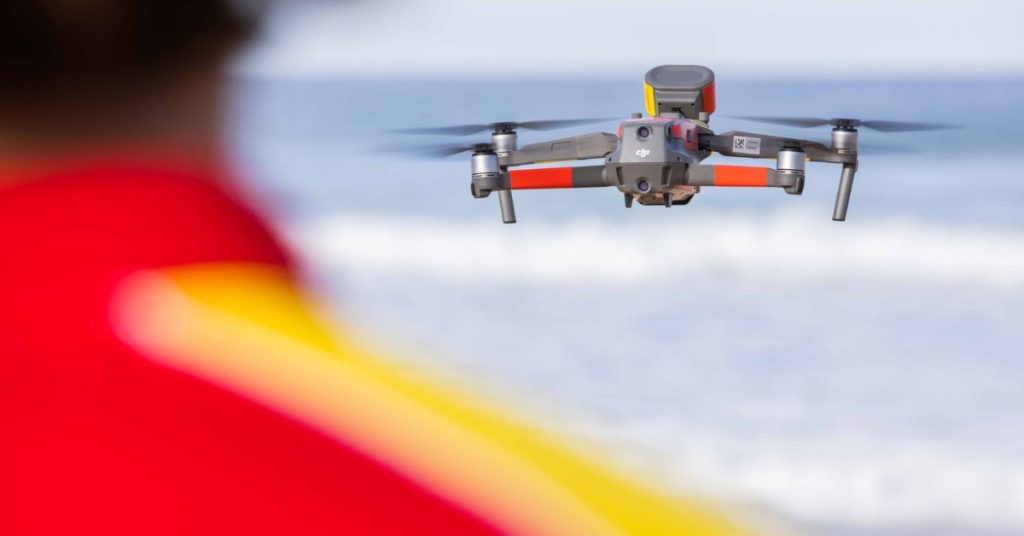
Shark-spotting drones will fly from dawn to dusk over Coogee Beach and 37 other Sydney beaches year-round as part of a $34 million expansion of NSW’s aerial shark surveillance program — the largest expansion of its kind anywhere in the world.
The expanded program begins on 1 July 2026. The announcement comes less than three weeks after a great white shark attacked 34-year-old Leah Stewart at Coogee Beach on 13 June 2026. Stewart was critically injured and later had her arm amputated.
The incident sent shockwaves through the Eastern Suburbs and prompted an immediate emergency drone deployment at the beach while the expanded program was finalised.
The broader expansion, delivered through Surf Life Saving NSW, lifts Sydney’s drone-monitored beach count from 26 to 38, covering the coastline from Palm Beach to Cronulla. Coogee and the surrounding Eastern Suburbs beaches are part of that expanded network. Statewide, 72 NSW beaches will receive drone coverage under the programme.
Dawn-to-dusk patrols, every day of the year
The scale of the expanded programme represents a significant shift from what has previously been available. Sydney beaches will now receive year-round drone patrols flying from first light to last light, every day of the year, rather than coverage concentrated in summer and school holidays. Regional NSW beaches will receive daily flights from 1 December to 30 April, plus flights every weekend throughout the year.


Coverage extends beyond patrolled beaches to include popular surf breaks and unpatrolled locations that have historically sat outside surveillance reach.
The programme will also deploy two SharkSmart listening stations in Sydney Harbour, designed to detect the presence of tagged sharks and alert swimmers and beach managers in real time.
Surf Life Saving NSW Chief Executive Steve Pearce described the funding as an investment in community confidence as much as technology. “This is an incredible investment in community, safety, confidence and ensuring NSW has cutting edge technology and capacity to provide world class safety to NSW coastal users,” Pearce said.

He noted the scale of what the programme has already achieved. “The SLS NSW Shark UAV surveillance program has this year alone identified and prevented over 2,000 sharks interacting with swimmers and surfers, and conducted over 100,000 flights,” Pearce said. “Even with the greatest technology and expanded presence of drones, we cannot prevent all shark interactions, however this funding will allow the development of a safety program that will give the greatest opportunity to prevent these from occurring.”
Artificial intelligence enters the water safety picture
The expanded programme pairs drone coverage with emerging technology. Surf Life Saving NSW will trial at least two new artificial intelligence systems over summer 2026-27, applying automation to improve shark detection accuracy and speed.
The long-term ambition is to make autonomous drone operations standard practice at NSW beaches, with regulatory work underway with the Civil Aviation Safety Authority to enable daily automated flights launching from surf club rooftops and purpose-built infrastructure.

The funding also allows Surf Life Saving NSW to upgrade its remote pilot and operating facilities and build the capacity needed to deploy new technology at scale as it becomes available.
Surfing NSW President Lusus Townsend welcomed the expanded coverage. “This is a win for surfer safety all along our coast, with increasing coverage across more beaches, for more hours, and more days of the year,” Townsend said. “Aerial shark surveillance is helping to make surfing as safe as it can be for our thousands of surfers along the NSW coast.”
Daily drone patrols come to Coogee
For Coogee Beach regulars, the programme’s start on 1 July means drone patrols will be overhead from sunrise through to sunset every day, including winter months when beach usage drops but ocean activity — including surfing, diving and open water swimming — continues year-round.
The $34 million expansion brings the total investment in NSW’s Shark Mitigation Program to more than $120 million over the next two years. While drones have limitations including weather conditions, visibility constraints and battery life, they remain the most scalable and cost-effective broad-coverage surveillance tool currently available for coastal shark monitoring.
Beach users are encouraged to check SharkSmart for near-real-time information on shark sightings and tagged shark detections.
Published 30-June-2026